
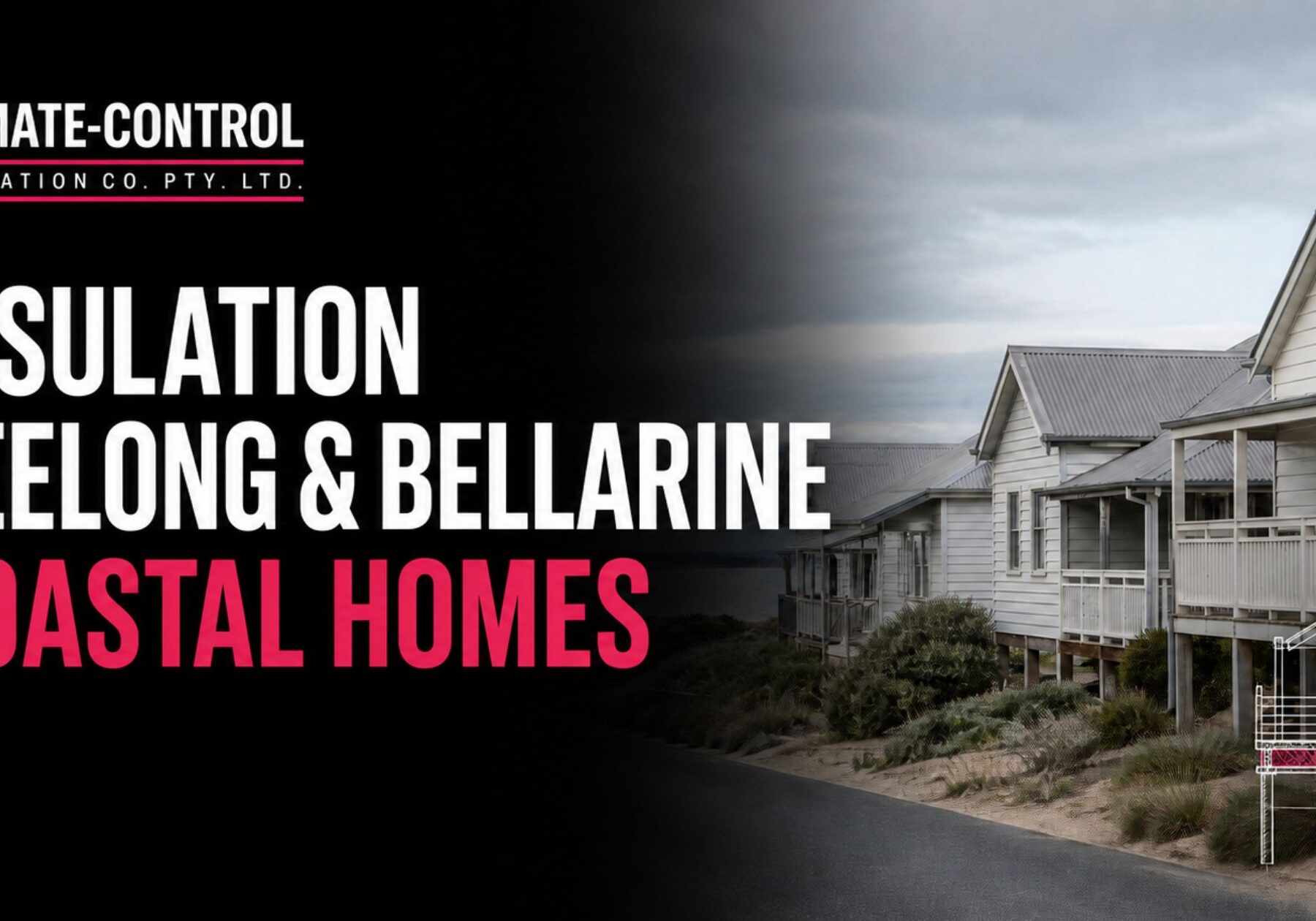
Coastal insulation Geelong homeowners buy often fails early, and not because of the R-value. A house a few streets back from Corio Bay has a different problem to a similar house in Balwyn.
Insulation for coastal homes must withstand conditions inland housing never sees. Here is what the coastal climate does to the thermal performance of a ceiling, a wall and a subfloor.
Three mistakes cause most of it: specifying on R-value alone, letting batts stop short of the ceiling edge where wind strips their performance, and ignoring the moisture that stops them ever drying out.

What The Coastal Climate Does Differently
Coastal air carries far more moisture than inland air, and homes in a coastal area sit in it all year. Bulk insulation achieves its thermal resistance by trapping still air within its fibres, and water conducts heat far more effectively than air. A batt that has absorbed moisture therefore loses much of its rated R-value while it remains damp.
Where the damp keeps coming back, the material compresses for good and never recovers its loft. That is the key point in coastal insulation Geelong homeowners encounter. Wet insulation does not dry out and return to its rated performance unassisted. It fails slowly while still looking intact from the manhole.
Steady wind exposure drives air into roof spaces and beneath suspended floors at rates sheltered inland suburbs never see. Air movement across poorly fitted batts produces wind washing, a convective heat loss at the perimeter. Insulation frequently stops short of the ceiling edge, so a well specified product can underperform because of the way it was fitted.
Coastal temperatures are milder than inland, but they swing further within a day, so a properly insulated building envelope has to moderate heat gain and heat loss between morning and evening.
Melbourne and the Geelong region occupy the same NCC climate zone, so the required R-value targets are identical. The climate zone sets the target. It says nothing about the effect of salty air and continuous wind exposure on installed insulation.
Does Salt Air Damage Insulation?
Not directly. Salt does not degrade glasswool fibres. Salt air damages metal, so fixings, foil facings and exposed fastenings sustain the salt damage on a coastal job rather than the insulation itself.
The moisture that comes with it causes the real problem. It explains why coastal properties more often need insulation stripped out and replaced rather than topped up. New batts installed over material that has been damp for years hide the damage instead of fixing it.
Suspended Floors Are The Region’s Blind Spot
Much of the older housing stock through Geelong West, Newtown, Belmont and the older parts of Werribee is weatherboard on stumps above an open subfloor. The approach suits coastal ground, but it leaves a large uninsulated surface exposed to continuous air movement.
An uninsulated suspended floor undoes much of the benefit gained at ceiling level, because heat escapes downward as readily as upward and the floor is the surface occupants contact directly. Owners report cold floors and untraceable draughts rather than naming it as an insulation problem, which is why it lasts for years.
Two factors determine whether underfloor insulation in a weatherboard home performs over time. The product must carry an underfloor rating and stay fixed in place, because material retained by friction alone eventually falls as vapour movement and air pressure act on it. The existing subfloor ventilation must also stay clear.
Underfloor insulation for homes on stumps is generally the largest remaining improvement available to a coastal property.
Ceiling Insulation Still Does The Heavy Lifting
Ceiling insulation remains the highest return job in almost any home. In winter, heat escapes through the ceiling faster than through any other surface. In summer, the roof space reaches temperatures far above the outside air and radiates that heat into the rooms below all afternoon.
Ceiling insulation moderates both conditions, so it contributes more to household energy efficiency than any other single job. We recommend it first wherever a budget stretches to one job only. Most properties in the region require R4.0 to R7.0 at ceiling level, set by the roof type, the depth available and the state of any existing material.
Walls, And Why Renovation Timing Matters
Wall insulation is inexpensive while the framing remains open and far more expensive once it is closed. Coastal weatherboard homes are reclad, extended and renovated more frequently than most. Each job is a window where external wall insulation adds little cost to work already booked.
Internal wall insulation deals with noise rather than thermal performance. It belongs in the same stage for the same reason.
Coastal insulation Geelong: what we look for on site
The roof space and the subfloor establish most of what a quote requires. Our installers assess:
- Moisture staining on the sarking, the structural timbers or the insulation itself
- Batts that have slumped, compressed or separated from the joists, which points to long term damp rather than a bad install
- Perimeter gaps at the eaves, and gaps around downlights, exhaust fans and manholes
- Whether existing material still performs and can be topped up, or has to come out
- Subfloor ventilation, and whether stored materials or later building work now block it
- Evidence of vermin, common in open coastal subfloors, which changes the scope of the work
Where We Install Around The Region
We install right along the western corridor, from Werribee, Werribee South, Point Cook, Wyndham Vale and Tarneit, down through Little River, Lara, Corio and Norlane, and across Geelong itself including Geelong West, Newtown, Highton, Belmont, Grovedale and Waurn Ponds. Geelong is where our regular run stops. Full details are on our home insulation Geelong page.
Frequently Asked Questions
Do you install insulation in Geelong, Werribee and Point Cook?
Yes. The corridor from Werribee and Point Cook down through Lara and Corio into Geelong is part of our regular service area, alongside Melbourne and the Mornington Peninsula. Geelong is the southern end of that run. Further detail is on our home insulation Geelong page.
Does salt air damage insulation?
Salt air does not degrade glasswool itself, because moisture rather than salt causes the damage. Insulation that absorbs water loses much of its thermal resistance while damp, and compresses for good where the damp keeps up. Metal fixings and foil facings sustain the most direct salt damage.
Is underfloor insulation worth it in a weatherboard home?
Generally yes. In an older weatherboard home on stumps near the bay it is frequently the largest improvement remaining. An open subfloor under continuous air movement drives heat losses all winter, and it affects the surface occupants stand on.
What R-value do Geelong homes need?
Ceilings in the region usually need R4.0 to R7.0. The figure depends on the roof space, the existing insulation and the standard the home has to meet, so we measure before quoting.
How much does insulation cost in Geelong?
Price reflects the area covered, the R-value specified and the access. Our guide to the cost of insulation explains what drives it, and a free measure and quote establishes the figure for a specific property.
Coastal homes are not harder to insulate. They are far less forgiving of work done without looking at what the climate is doing to the building.
Anywhere from Werribee and Point Cook down through Lara and Corio into Geelong, we will inspect the roof space and the subfloor and establish what is actually there before talking about products.
Request a free measure and quote or call 13 12 24. Insulating Victorian homes since 1965.