
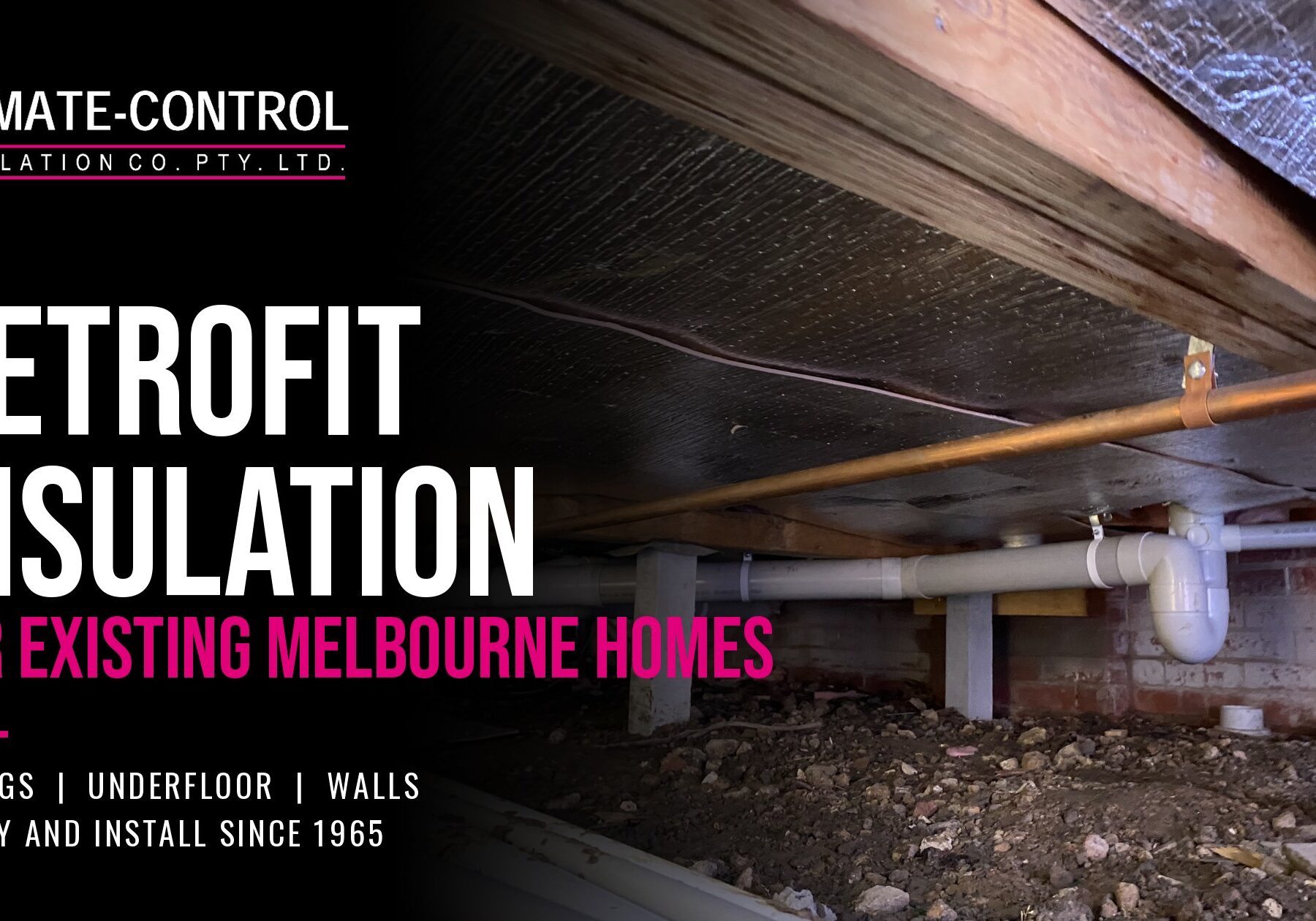
Walk into a lot of Melbourne homes built in the 1960s, 70s or 80s and open the ceiling manhole, and you’ll often find the same thing. Bare timber joists, a thin layer of grey fibre that has settled over decades, or a few old batts pushed aside by the last electrician. Underneath, the timber floor sits on stumps with nothing between the boards and the cold air below.
The good news is that most of this can be fixed without a renovation. Retrofit insulation is the process of adding insulation to a finished home, and in most Melbourne houses the biggest gains come from areas you can reach without opening a single wall. This guide covers what can be insulated in an existing home, what’s harder, what it costs and where the Victorian rebate fits.
What Retrofit Insulation Actually Means
In a new build, insulation goes in while the frame is open. Batts are fitted into the wall studs, the ceiling and the floor before any linings go on, so access is easy and every space can be filled.
An insulation retrofit works the other way around. The house is finished, people are living in it, and the installer has to reach each space through the access that already exists. That changes what’s practical. Ceilings and suspended floors are usually easy because there’s a manhole above and a subfloor below. Walls are harder because the cavity is closed on both sides.
Insulating an existing home also means dealing with what’s already there. Old insulation, electrical cabling, downlights, ducting and the occasional possum nest all need to be checked before new product goes in.
Why Retrofit House Insulation Pays Off in Melbourne
Melbourne sits in climate zone 6, with cold winters and hot spells through summer. A home without insulation loses heat fast in winter and soaks up heat through the roof in summer.
According to the Australian Government’s YourHome guide, ceilings and roofs account for 25 to 35% of winter heat loss in a typical home. Walls account for 15 to 25%, and floors 10 to 20%. That’s why retrofit house insulation usually starts at the ceiling and works down.
With retrofit insulation in place, the heating and cooling you already have doesn’t need to work as hard.Rooms hold their temperature for longer, upstairs bedrooms stay cooler on hot afternoons, and energy efficiency improves without changing anything else in the house.
There’s also a rental angle. From 1 March 2027, Victorian rental providers must install R5.0 ceiling insulation in any ceiling space that has none when a new rental agreement starts. If you own an older rental property, retrofit insulation now avoids a rush later.
Ceilings: The Easiest and Biggest Win
On most retrofit insulation Melbourne jobs, the ceiling is where the work makes the most difference for the least disruption. Ceiling retrofit insulation is done from inside the roof space, through the existing manhole, and most homes are finished in a day.
There are two common situations:
- No insulation at all. Bulk insulation batts go in between the ceiling joists across the whole ceiling. For Melbourne homes, R4.0 to R6.0 gives good results, and R5.0 ceiling insulation is a popular middle ground.
- Old, thin or patchy insulation. If the existing insulation is dry and clean, new batts can often be laid over the top to lift the total thermal resistance. If it’s damp, contaminated or badly compressed, it’s better to remove it first.
Downlights need extra care. Older halogen downlights run hot and need clear space around them, while modern IC-4 rated downlights can be covered. Your installer should check every fitting before any batts go in.
Underfloor: If You Can Get Under It, It Can Be Done
Many older Melbourne homes have suspended timber floors on stumps. Cold air moves freely underneath, and without insulation those floors can feel cold underfoot for most of winter.
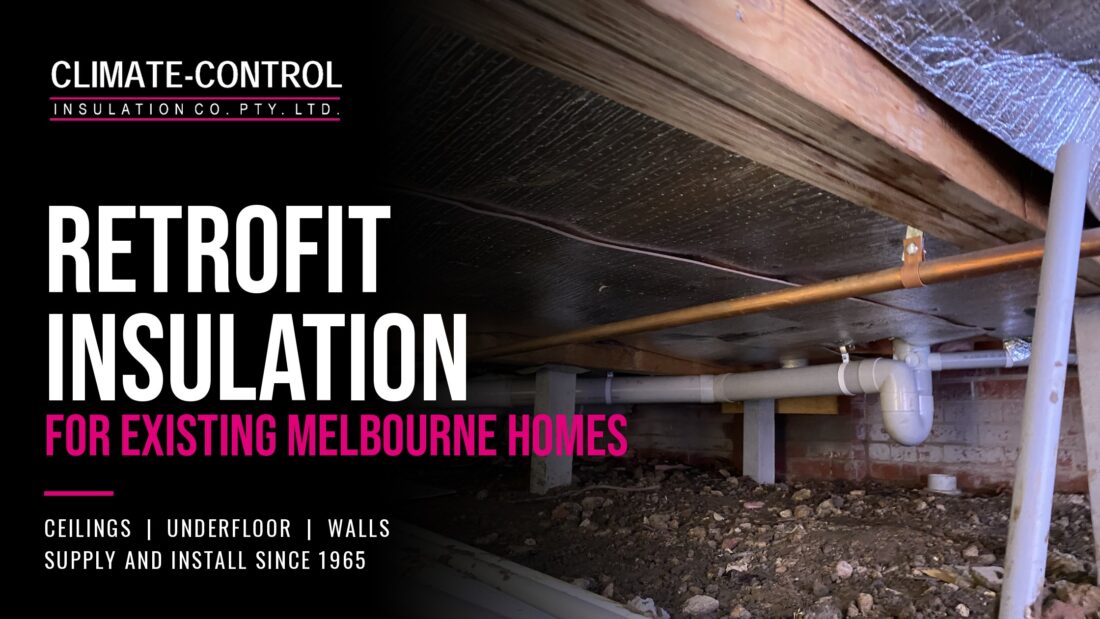
If there’s enough crawl space for an installer to work, underfloor insulation can be fitted from below with no change inside the house. Batts are pushed up between the floor joists and held in place with insulation strapping so they don’t sag over time. Our underfloor insulation service covers the details.
Concrete slab floors are different. There’s no space underneath to work, so underfloor insulation can’t be retrofitted to a slab.
Retrofit Wall Insulation: The Hard One
Walls are the part of an existing home that’s hardest to insulate. The cavity is closed on both sides, with plasterboard inside and brick or cladding outside, so there’s no easy way to fit batts properly.
The most reliable time for retrofit wall insulation is when the wall is already open. That usually means:
- During a renovation, when internal linings come off for new plaster, wiring or plumbing
- When cladding is replaced, which opens the wall from the outside
- During an extension, where new and existing walls can be done at the same time
If you’re planning a renovation, it’s worth booking insulation into the schedule before the plasterers arrive. Our internal wall insulation and external wall insulation pages explain the options. We’re always happy to look at your wall type at a measure and quote and tell you what’s practical.
On most retrofit wall insulation Melbourne jobs, the product cost is rarely the big number. The cost comes from opening and closing the wall, which is why timing it with other work makes such a difference.
What to Check Before You Start
Good retrofit insulation work starts with an inspection of what’s already in the roof and under the floor. Before any new insulation goes in, check for:
- Damp or water damage. Staining, mould or wet insulation points to a leak that needs fixing first.
- Compressed or displaced insulation. Batts that have been walked on or pushed aside lose most of their value.
- Vermin. Droppings or nesting material usually mean the old insulation should come out.
- Wiring and downlights. Damaged cabling or old halogen fittings need an electrician before insulation goes near them.
If what’s up there needs to go, our guide to removing old insulation explains the process.
What Retrofit Insulation Costs
Retrofit insulation cost depends on the area, the R-value, access and whether old insulation needs removing. As a guide, installed ceiling insulation in Melbourne typically sits between $800 and $2,500 for an average home, depending on the R-value chosen.
Underfloor work depends heavily on subfloor access. Walls vary the most, because the cost of opening and closing the wall usually outweighs the product. Our guide to insulation costs in Melbourne has more detail on price ranges.
Where the Victorian Rebate Fits
Since 1 October 2026, eligible Victorian homes with little or no ceiling insulation can get a discount through the Victorian Energy Upgrades program. It covers ceilings only, in homes where existing insulation averages less than R2.0.
Walls, underfloor insulation and ceiling top-ups above R2.0 sit outside the program. Our guide to the Victorian insulation rebate explains who qualifies and how it works.
Frequently Asked Retrofit Insulation Questions
Can you insulate an existing house without removing walls?
Yes. Retrofit insulation for ceilings and suspended timber floors doesn’t touch the walls. Ceilings are done from the roof space and floors from the subfloor. Walls are the one area that’s best done when the linings or cladding are off.
Is it worth topping up old ceiling insulation?
Usually, yes. Insulation that has settled over 20 or 30 years has lost much of its original thermal resistance. Adding new batts over clean, dry insulation can lift the ceiling to R5.0 or R6.0.
Can underfloor insulation be added to an existing house?
Yes, if the home has a suspended floor with enough crawl space underneath. Batts are fitted between the joists and held with strapping. Homes built on a concrete slab can’t be retrofitted from below.
How long does retrofit insulation take?
A ceiling retrofit in an average home usually takes a day. Underfloor work depends on access. Walls are done as part of the renovation schedule.
What is the typical retrofit wall insulation cost Australia-wide?
It varies more than any other retrofit, because the cost of opening and closing the wall is usually bigger than the cost of the insulation. Doing it during a renovation or recladding job keeps the retrofit wall insulation cost much lower than a standalone job.
Book a Free Measure and Quote
Climate Control Insulation has been insulating Melbourne homes since 1965. We’ll inspect your ceiling and subfloor, tell you what’s worth doing and what isn’t, and give you a clear quote for your retrofit insulation. Call us on 13 12 24 or request a free measure and quote.