
Ceiling insulation vs roof insulation -if you’ve been comparing insulation options for your Melbourne home, you’ve probably wondered whether they’re the same thing. They’re closely related, but they refer to different products installed in different locations. Understanding the difference helps you choose the right solution for your home. They’re closely related, but they are not interchangeable. The difference comes down to where the insulation is installed and what type of roof or ceiling design your home has. Understanding that difference helps you choose the right solution, avoid paying for the wrong product, and get better thermal performance from your home. For many Melbourne properties, the answer is straightforward: ceiling insulation is the priority. But in some homes, particularly those with skillion roofs or cathedral ceilings, roof insulation may be essential.
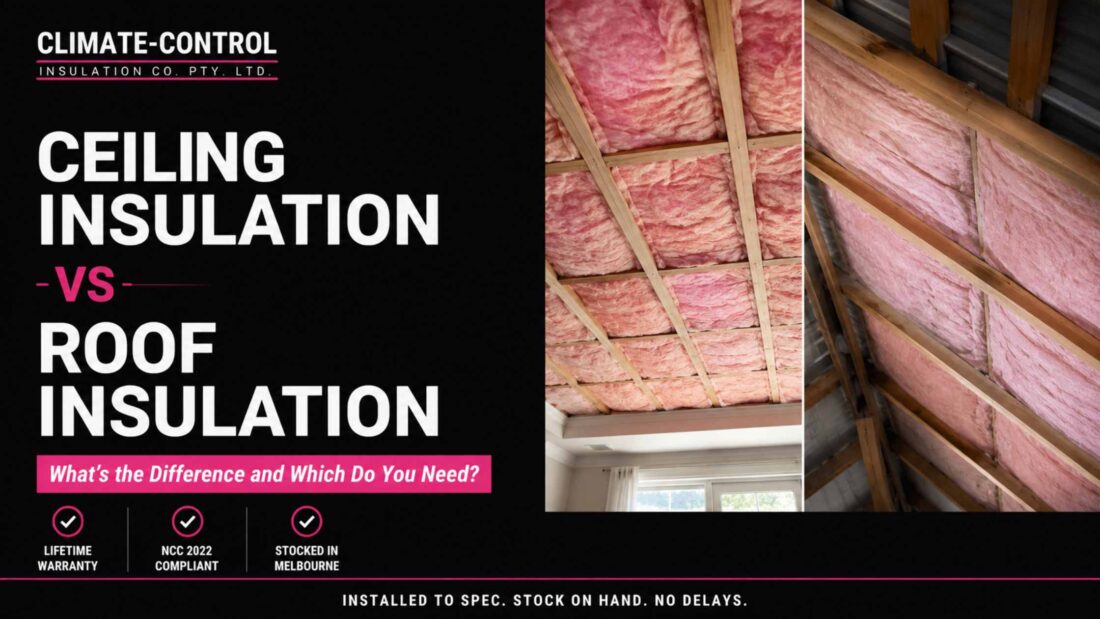
Ceiling insulation vs Roof Insulation Blog Banner
What Is Ceiling Insulation?
Ceiling insulation is installed on top of the ceiling joists, across the flat horizontal ceiling above your living spaces. In other words, it sits between the rooms below and the roof space above.
This is the most common insulation setup in Australian homes, especially where there is a standard roof cavity that can be accessed from inside the roof space. In most cases, ceiling insulation is installed as batts laid between and across joists, although some homes may use loose-fill products.
For most Melbourne households, ceiling insulation is the single most effective place to start. A large amount of winter heat escapes through an uninsulated ceiling, which means your heating system has to work harder to maintain a comfortable indoor temperature. That is why upgrading your ceiling insulation often delivers the strongest return for the cost.
Products such as Pink Batts R5.0 and Bradford Gold R6.0 are popular choices for Melbourne homes. Because Melbourne sits in Climate Zone 6 under the NCC, higher-performing ceiling insulation products are often recommended to improve year-round energy efficiency.
Another reason ceiling insulation is so widely chosen is that installation is usually straightforward. In a standard home with accessible roof space, the job can often be completed with minimal disruption.
You can explore options on our Ceiling Insulation page, including recommended products for existing homes and new builds. According to the Australian Government’s YourHome guide, roof and ceiling insulation can save up to 45% on heating and cooling costs.
What Is Roof Insulation?
Roof insulation refers to insulation installed against the underside of the roof cladding or as part of the roof system itself. This means it follows the sloped roof line, rather than sitting on the flat ceiling below.
Roof insulation is commonly used in homes or buildings where there is no conventional ceiling cavity. This includes:
- Skillion roofs
- Cathedral ceilings
- Exposed rafter designs
- Some architectural homes with limited roof access
- Commercial buildings
- Roof systems that include reflective sarking under tiles or metal roofing
If you have been asking what is roof insulation, the simplest answer is this: it is insulation designed for the roof structure itself, rather than the ceiling plane beneath it.
This matters because not every home has enough accessible space above the ceiling to install traditional batts. In those cases, insulation may need to be fitted under the roof line or integrated into the roof build-up.
Roof insulation can also be used alongside ceiling insulation. In some older homes or more complex roof designs, combining the two can improve overall thermal performance and help manage summer heat gain as well as winter heat loss.
If your home has an unconventional roof design, or you are looking at insulation for a skillion roof, roof insulation is usually the right place to focus.
Learn more about solutions on our Roof Insulation page. That’s the core of the ceiling insulation vs roof insulation question — one treats the ceiling plane, the other the roof structure
Ceiling Insulation vs Roof Insulation: Key Differences at a Glance
Here’s how ceiling insulation vs roof insulation compares at a glance:
Ceiling insulation
- Installed on the flat ceiling joists
- Best suited to homes with a traditional roof cavity
- Usually the highest-value upgrade for Melbourne homes
- Quick to install with minimal disruption
- Commonly installed using bulk insulation batts
Roof insulation
- Installed on the sloped underside of the roof
- Essential for skillion roofs and cathedral ceilings
- Often includes sarking or specialised insulation systems
- Useful where there is no accessible ceiling cavity
- Can be combined with ceiling insulation in some homes
In short, ceiling insulation addresses the ceiling plane, while roof insulation addresses the roof line itself.
Ceiling insulation vs Roof Insulation – How Melbourne’s Climate Affects Your Decision
Melbourne’s weather puts insulation to the test more than most Australian cities. Cold, damp winters mean sustained heat loss through the roof and ceiling for months at a time, while summer heatwaves push roof cavity temperatures well above 50 degrees. A home that isn’t properly insulated ends up expensive to heat in July and uncomfortable to live in come January.
This is why the ceiling insulation vs roof insulation decision matters more here than in milder climates. In winter, warm air rises and escapes through the ceiling plane, so a well-insulated ceiling directly reduces how hard your heating has to work. In summer, the roof itself absorbs radiant heat all day, and that heat travels down into the home -which is where roof insulation and reflective sarking earn their keep, particularly under dark tiles or metal roofing.
Older Melbourne homes add another layer to the decision. Many houses built before the 1990s have thin, compressed, or patchy ceiling insulation that has settled well below its original performance. If your home is in this category, upgrading the existing ceiling insulation usually delivers a bigger improvement than adding anything to the roof line. Newer builds and extensions, on the other hand, are more likely to feature skillion roofs or raked ceilings where roof insulation is the only practical option.
Orientation and roof colour play a part too. A west-facing home with a dark metal roof will gain far more summer heat than a light-coloured tiled roof shaded by trees and may justify insulating both the ceiling and the roof line. There’s no single right answer for every Melbourne home -which is exactly why an on-site assessment beats guesswork. Our installers see the full range of Melbourne housing stock every week, from Victorian weatherboards in the inner north to new estates on the fringe and can tell you quickly which approach will give you the best result for your budget.
Which Do You Need?
For most Melbourne homeowners weighing up ceiling insulation vs roof insulation, ceiling insulation is the priority.
That is because a standard home with a pitched roof and accessible roof cavity will benefit most from insulating the flat ceiling area. It is typically the most effective way to reduce heat loss in winter and improve the energy efficiency of the home without major building work.
However, not every home is built the same way.
If your property has:
- a skillion roof
- exposed rafters
- a cathedral ceiling
- or no accessible ceiling cavity
then roof insulation may be the better option, or the only practical one.
Some homeowners also choose to install both ceiling and roof insulation, particularly in older properties or homes that experience extreme indoor temperature swings. In those cases, a combined approach can help improve overall thermal performance.
The best way to decide is to assess the structure of the home first. The right recommendation depends on how your roof is built, what insulation is already in place, and what access is available.
At Climate Control Insulation, we assess the roof space and recommend the most suitable solution for your home. We’ve been insulating Melbourne homes since 1965, and we can help you avoid guesswork and choose the right system from the start.
To compare product options, you can also view our Pink Batts and KIngspan product pages.
Get the Right Insulation for Your Melbourne Home
If you are unsure whether you need ceiling insulation vs roof insulation, or both, the best next step is a professional assessment.
Choosing the right insulation is not just about product type. It is about making sure the insulation matches the design of your home and is installed in the correct location for the best result.
Get a free insulation assessment. Contact Climate Control Insulation today on 13 12 24 or request a quote online through our Contact / Free Quote page.
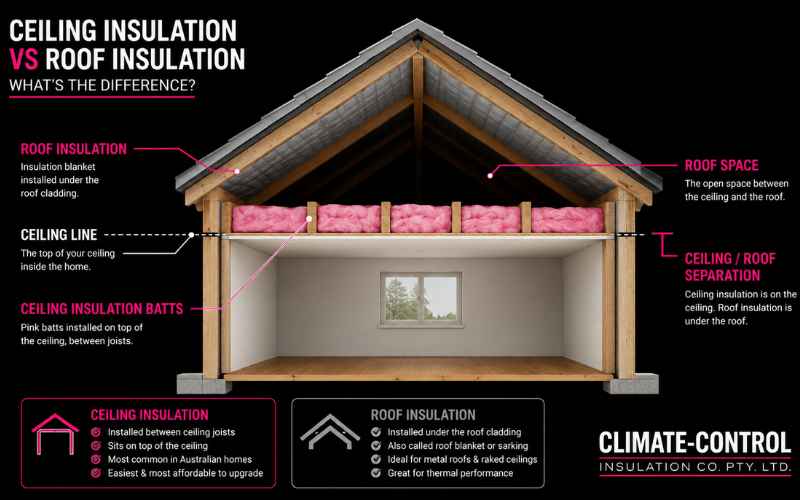
Ceiling insulation vs Roof Insulation Visual Diagram
FAQs
Ceiling insulation vs roof insulation: is it the same thing?
When comparing ceiling insulation vs roof insulation, the difference is location: ceiling insulation sits on the flat ceiling joists, while roof insulation is applied under the sloped roof.
What R-value do I need for ceiling insulation in Melbourne?
Melbourne is in Climate Zone 6. For new homes, the NCC commonly requires ceiling insulation around R5.0 depending on the overall building design and energy assessment. In many existing homes, upgrading to R5.0 or R6.0 can make a noticeable difference.
Can I have both ceiling and roof insulation?
Yes. Some homes use both ceiling and roof insulation for improved thermal performance. This can be particularly useful in older homes, homes with complex roof designs, or homes that get very hot in summer and cold in winter.
Ceiling Insulation vs Roof Insulation: Cost Comparison
Cost is usually where the ceiling insulation vs roof insulation decision becomes clearer. Ceiling insulation is generally the more affordable of the two, because the materials are widely available and installation in an accessible roof cavity is quick — most standard Melbourne homes can be completed in a few hours. Bulk batts such as Pink Batts R5.0 or Bradford Gold R6.0 deliver strong thermal performance at a competitive price per square metre, which is why ceiling insulation consistently offers the best return on investment for established homes.
Roof insulation tends to cost more, simply because the work is more involved. Insulating along the roof line often means working with rigid boards, blanket systems, or sarking installed as part of the roof build-up — and in existing homes, it may require partial removal of roofing material. That said, for skillion roofs and cathedral ceilings it isn’t a premium option; it’s the only option, and it’s far more economical to include during construction or re-roofing than to retrofit later.
The good news is that both approaches pay for themselves over time through lower heating and cooling bills. The right way to compare costs isn’t product price alone — it’s the installed cost against the energy savings for your specific home. That’s something we can calculate for you as part of a free, no-obligation quote.
Still weighing up ceiling insulation vs roof insulation? Get a free assessment — we’ll inspect your roof space and recommend the right option