
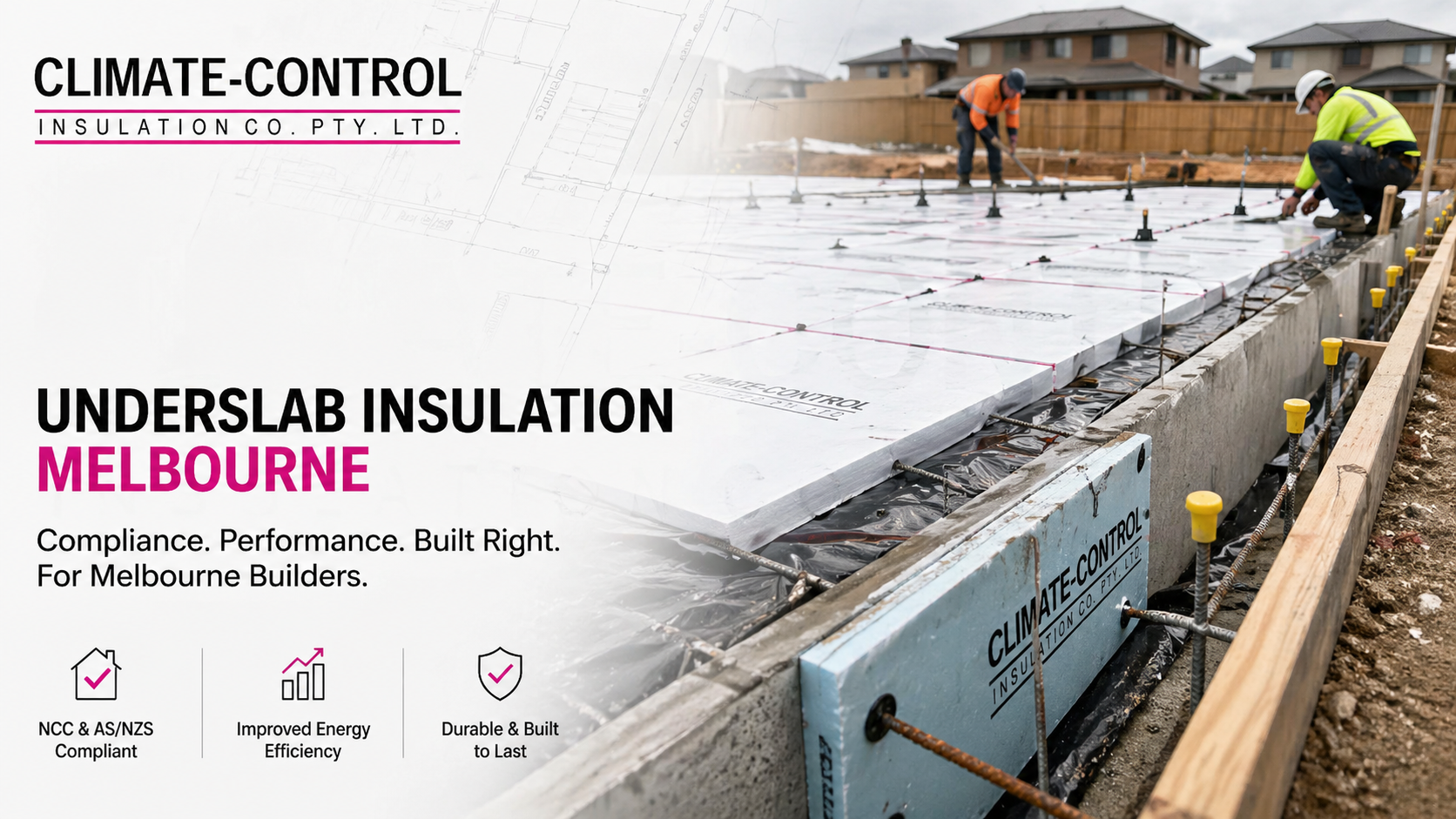
In Melbourne, slab edge insulation requirements is not a last-minute slab detail. Builders need to check it early against the energy report, slab design, permit documents and site sequence.
Projects usually do not go wrong because insulation was missing from the paperwork. They go wrong because teams miss the correct product, slab edge detail or install method until multiple trades are already moving.
Need it supplied and installed? We fit slab edge and underslab insulation as part of our insulation services for builders, timed to your pour.
Once the slab is poured, rework becomes expensive and difficult.
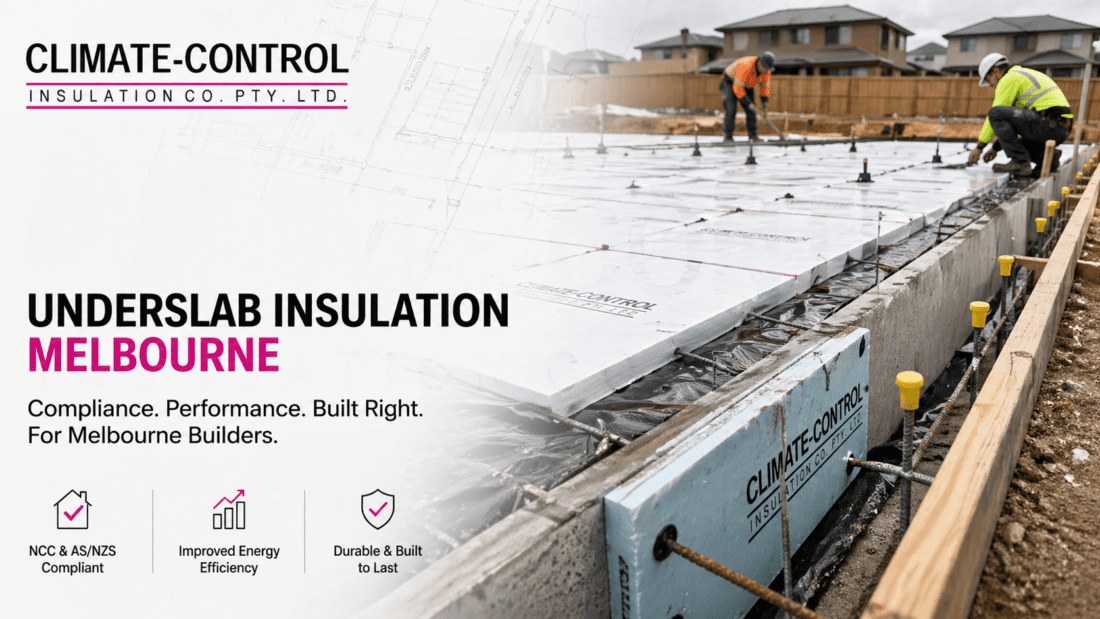
When builders need underslab insulation in Melbourne
Underslab insulation requirements usually come from the project’s energy report and approved documents. They do not come from guesswork or a standard site assumption.
For new residential projects in Victoria, builders need to meet NCC insulation requirements shown in the approved documentation. That means the permit set, energy report and slab detail all need to line up before materials are ordered or installed.
Builders will usually see underslab insulation or slab edge insulation specified when:
- the energy report calls it up to meet performance targets
- the slab design includes a thermal break or perimeter insulation detail
- the project includes in-slab heating or cooling
- the design team needs to improve thermal performance at the slab edge
- the slab-on-ground detail requires better control of heat transfer
This is why slab insulation for builders needs to be checked early. It affects procurement, sequencing and compliance before the slab crew arrives on site. In many cases, those documents also set out slab edge insulation requirements that builders need to follow before the pour.
Slab edge insulation requirements builders must check
This detail often gets missed because it sits across several documents and trades.
The designer may show it on a section.
The energy assessor may note it in the report.
The engineer may issue the slab detail separately.
The site team may only notice it when booking materials.
That sequence creates problems. By that point, slab prep may already be underway and several trades may already be locked into the program.
Builders should confirm the correct product, slab edge detail and install method before slab prep, waterproofing, termite treatment and concrete works overlap.
Underslab insulation and slab edge insulation are not the same
These terms often get grouped together on site, but they do different jobs.
Underslab insulation usually refers to rigid insulation installed beneath the slab or slab elements.
Slab edge insulation sits at the slab perimeter to reduce heat loss at one of the highest-transfer points in the slab system.
Both details can affect compliance. Both need to match the approved documentation. And both need to be installed properly before the pour.
On many jobs, the slab edge is the detail that gets missed first. Teams may understand the slab system overall, but still value-engineer, miss or inconsistently install the perimeter detail.
Slab edge insulation requirements builders must check
Builders should check the following before the pour.
1. Match the energy report and approved documents
The insulation detail on site must match the approved drawings and energy report insulation requirements.
That includes:
- product type
- thickness
- location
- slab edge detail
- required performance outcome
If the report specifies a slab edge detail or R-value, builders should not swap products without checking compliance first.
This is where insulation to spec Melbourne matters. This is also where slab edge insulation requirements are most often missed or installed incorrectly. The product supplied and installed must match the approved design, not a rough equivalent or a standard substitution.
2. Check slab edge insulation requirements properly
The slab edge detail is often where the risk sits. Even when the centre slab area is clear, the perimeter condition can still cause problems.
Builders should review:
- slab perimeter junctions
- set-downs and rebates
- door thresholds
- garage-to-house transitions
- external wall interfaces
- penetrations and service entries
If the slab edge detail is incomplete, crews can install the wrong product, leave gaps or create a non-compliant finish.
3. Make sure the product suits the application
The product must suit the job, not just the drawing note.
Builders need to check:
- compressive load requirements
- moisture exposure
- slab system type
- site conditions
- installation method
A rigid board product used under a concrete slab must be suitable for that application. The same applies to any perimeter board used to meet slab edge insulation requirements.
4. Coordinate with other site requirements
Underslab insulation does not sit on its own. It needs to work with the rest of the slab package.
Builders should coordinate it with:
- termite management
- moisture control
- waterproofing details
- engineering requirements
- set-out and sequencing
Late changes in any of these areas can create install issues, missed details or delays before the pour.
5. Lock in supply and install timing early
Late identification of underslab or slab edge insulation can disrupt procurement, slab prep, inspections and pour sequencing.
This delay usually costs builders time.
If materials are not ready when the slab program is booked, the job can stall while teams try to confirm products, details and availability. That is avoidable when the insulation scope is reviewed early and handed to a supplier who understands the drawings.
Common mistakes that create delays and rework
Most underslab issues come from simple mistakes made too late in the process.
Assuming the note is enough
A broad note to comply with NCC requirements is not enough for site. Builders need clear documentation that shows what product goes where and how the detail needs to be installed.
Picking it up during procurement
If the first real check happens when materials are being ordered, the job is already under pressure. That leaves less time to confirm the correct product, perimeter detail and sequencing.
Missing the perimeter detail
The slab edge detail often carries the most risk. Teams can miss it completely, substitute it incorrectly or install it inconsistently around the perimeter.
Swapping products without checking the report
Builders should not substitute a product just because it looks similar on paper. The approved documentation and performance requirements still need to be met.
Leaving coordination too late
Underslab insulation touches multiple parts of the build. If teams do not coordinate it with termite treatment, waterproofing, engineering and slab prep, the builder carries the risk.
A practical pre-pour checklist
Before the slab is booked, Slab Edge Requirements builders should confirm:
- the energy report and plans both show the insulation requirement
- the product matches the approved detail
- the slab edge detail is resolved across the full perimeter
- thickness and location are confirmed
- termite and moisture requirements have been checked
- penetrations and transitions have been reviewed
- supply timing matches the slab program
- the installer understands the project-specific detail
This process helps builders avoid delays, compliance issues and rework after the slab is poured. Builders should review slab edge insulation requirements against the approved drawings before the slab is booked.
Why builders use an insulation partner for this scope
Underslab insulation is one of those details that can look simple until site conditions, documentation gaps and timing issues start colliding.
Builders do not need more noise around this scope. They need:
- stock on hand
- clear product selection
- installation to spec
- reliable scheduling
- fewer site issues before the pour
That is why builders use an insulation partner who understands documentation, sequencing and slab edge insulation requirements, not just product supply. It also means checking slab edge insulation requirements against the energy report and approved documentation.
Climate Control supports Melbourne builders with stocked insulation products, supply coordination and installation across a range of applications, including underslab insulation. We follow National Construction Code Energy Efficiency Requirements.
Final word
Underslab insulation in Melbourne is not just another line item in the slab package.
Builders need to align the insulation scope with the energy report, permit documents and site sequence before the pour. That includes the correct product, the correct slab edge detail and the correct install method.
When teams review it early, they avoid delays and reduce the risk of rework. When teams pick it up late, the builder carries the risk.
If your plans show underslab insulation or slab edge insulation, check it early against the energy report and approved details before you lock in the slab program.